To celebrate our City of Making exhibition as it enters its last few weeks at the New Adelphi Exhibition Gallery, Team Assistant Keira Marchant has interviewed featured artist Alfie Lane. Here we delve into Alfie’s artistic practice, the concepts behind his work, as well as the importance of the city of Salford to Alfie, who is a Salford Alumnus and a previous Graduate Scholar.
Could you give us a bit of an introduction to yourself as an artist and your practice?
I’m Alfie, and I’m an artist based at Islington Mill in Salford. I work in a range of mediums, primarily lino print, pencil drawings and sculpture. My practice explores the interplay of nature and technology through the lens of an otherworldly civilisation.
Your drawings and collages centre around the concept of ‘sacredness’ amongst people, civilisations, and technologies – in what way do you seek to express this theme visually through your work?
As we become alienated from the natural world, I think many small routines become sacred – gathering people around a bonfire, collecting a harvest, even a simple thing like checking in on the garden every morning has a ritualistic element to it. Adapting religious iconography, decorative borders and symmetry is one way to convey that, as well as juxtaposing natural and artificial elements such as tree roots and cables, or the clean edges and lines of circuitry with flowing organic forms to display the interconnectedness of it all.
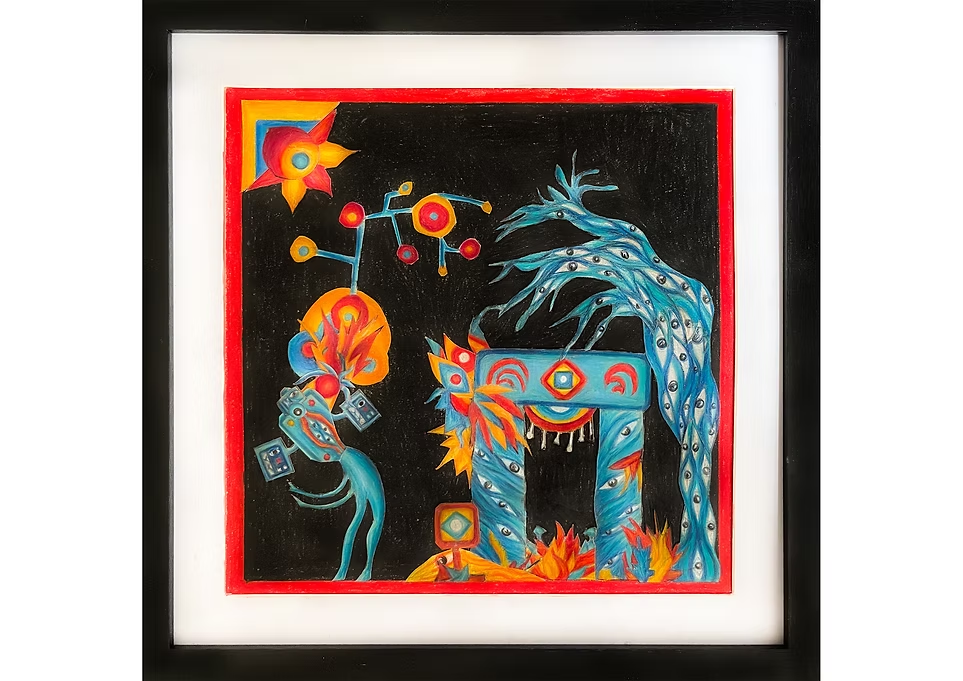
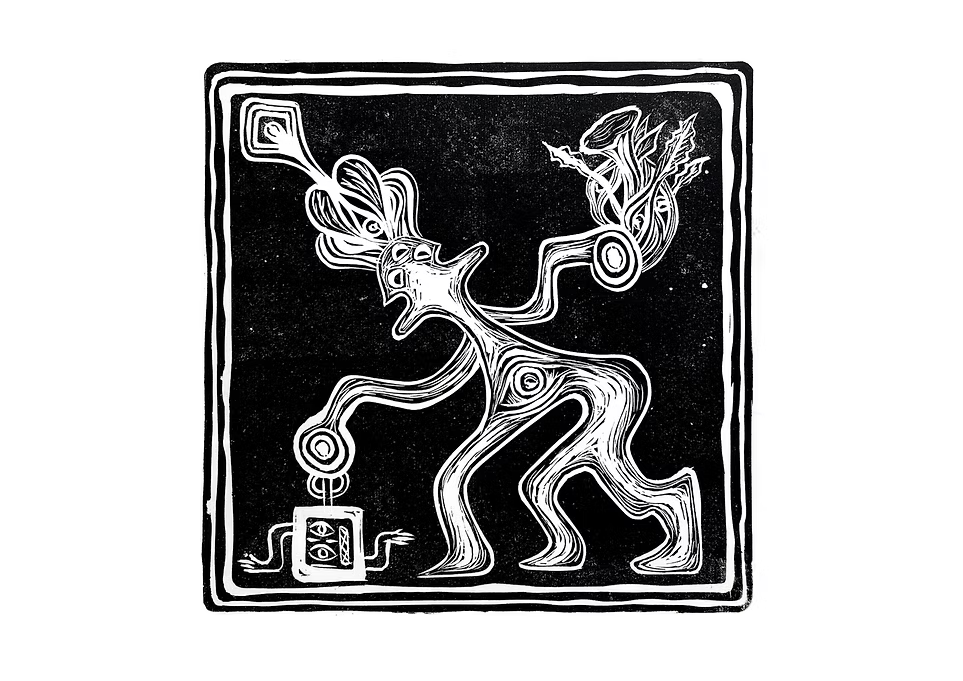
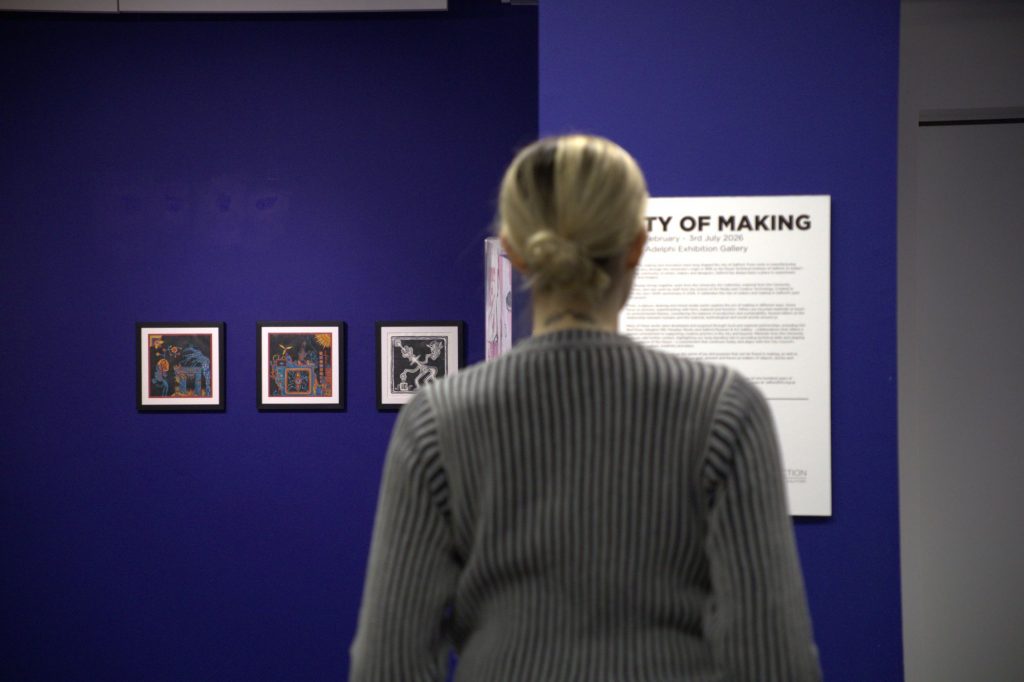
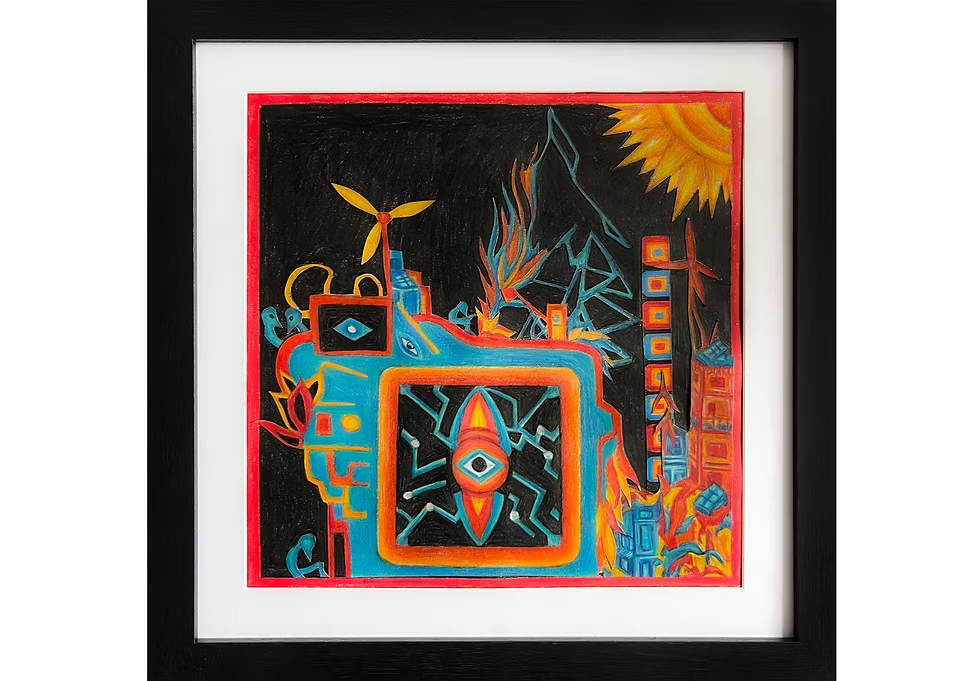
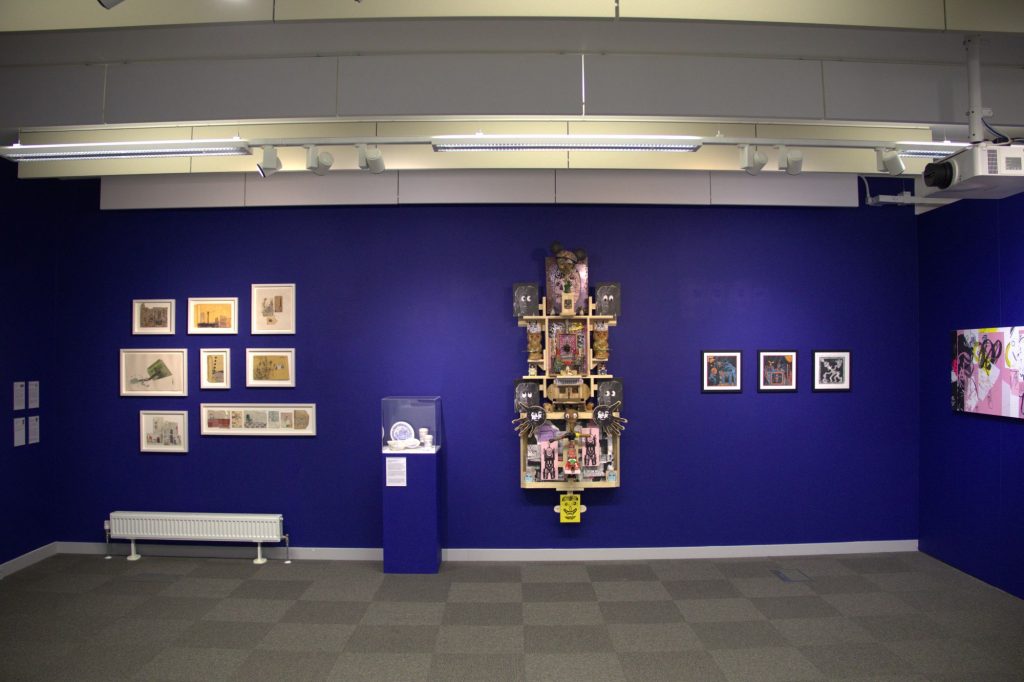
You have three artworks on display in our current City of Making exhibition, one titled Balance (2023) and two untitled works created in 2024. Could you tell us a bit about your intentions when making these works?
A lot of my initial ideas and motifs come from pencil sketches. I had so many drawings lying around at the time and wanted to repurpose them into new work, which is how both untitled pieces came to be. Balance started as a quick scribble in my sketchbook, which I then developed into a bigger piece and eventually a linoprint.
Technology is a broad term; we tend to visualise modern computers and phones, rather than the basic tools of civilisation. It can often feel like they are at odds with each other, yet they have a direct impact on one another. With modern ‘smart features’ in everything (why on earth do I need my fridge to connect to the internet?) and AI everywhere, computers imitate life, at the same time, life begins to imitate computers – society becomes increasingly simplified into short-form content that’s neatly packaged and categorised, everything becomes about stats and numbers and data. In turn, we become removed from the natural cycles and rhythms of the natural world. Finding a balance between it all can be tricky.
I think deep down there’s an old hippie inside me who just wants to turn off all the screens and potter in the garden all day long, though I do achieve it some days!
Folklore and myth are also elements which you explore within your artistic practice. Are there any specific areas of folklore and myth that capture your attention when conceptualising your works? This could be across different cultural traditions locally or globally.
I always loved ancient Egypt growing up, especially the hieroglyphics and the relief sculptures of various scenes of gods carved into the walls. Aztec and Mayan art, too – the use of symmetry in sculptures and stone carvings, the flat 2D compositions. I take a lot of inspiration from those civilisations to reflect modern life through the lens of the old.
Additionally, I’m drawn to the use of nature as a spiritual force. Not just in shamanic traditions, but closer to home, the Green Man and forest spirits, the Pagan wheel of the year and its seasonal festivals, and even down to knowledge on medicinal herbs. Most people know about Dock leaves to soothe nettle stings – I didn’t read that anywhere, my grandma taught me when I was really young! I think these traditions are important for keeping us connected to nature and for passing down knowledge to the next generation.
Our City of Making exhibition draws on Salford as a city created for and by creatives and makers. How does Salford, as a place and community, resonate with you as an artist who has studied and produced work here?
I’m originally from Leicester, so Salford always seemed a bit of a ‘dodgy’ place until I moved here. Since then, I’ve loved it. There is such a vibrant, creative community, and it feels good to be in a place where the arts scene isn’t on the sidelines; it’s a real integral part of the city.
Between Hot Bed Press, Paradise Works and Islington Mill, you are never short of advice and support from other creatives. Not just in terms of art but with other things too – we now have our own community gardens at Islington Mill and meet up regularly to look after it, we had a great afternoon painting murals last year to liven up the space too!
If the readers of this interview were to go away and look at the work of any artist who has inspired your practice, who would you recommend to them and why?
One of the first artists that springs to mind is Emma Talbot. I love the huge sprawling paintings she creates to explore shared human experiences and our connection to nature. Daniel Martin Diaz is another; he depicts visual elements from computer science, philosophy and physics as ancient-looking diagrams and has inspired the development of my own visual language. When I was at University, seeing John-Powell-Jones’ show ‘Cyberjunk’ at Castlefield Gallery was a turning point for me regarding how art and ideas can be channelled through so many different forms and media to tell a story.
I also take a lot of visual inspiration from films, particularly those which use colour and composition in an almost painterly way. The two main ones are The Colour Of Pomegranates by Sergei Parajanov and The Holy Mountain by Alejandro Jodorowsky. The latter is so beautifully crafted and uses an incredible visual language based on astrology and tarot to satirise all the main tenets of modern society at once. It’s a really amazing piece of art and one I come back to all the time.