Ahead of their highly anticipated, immersive art installation – From the Edges: Salford’s Hidden Landscapes, commissioned by the University of Salford Art Collection; Simon Connor and Andrew Brooks are giving us an exclusive insight into the background of their new artwork; due to be exhibited 3rd May at the 2026 instalment of Sounds from the Other City Festival.
Interviewed by Team Assistant Keira Marchant, the two discuss their inspirations, artistic practice and creative process.
- Where do you both find inspiration for your work? For example in arts, culture, nature or society?
Andrew Brooks: The heart of my creative practice is capturing and sharing how it feels to be in a place. Firstly by recording the look of a place, but then digging a little deeper and trying to bring out more subtle things, like the atmosphere and feeling of being there.
Lots of artists and artworks inspire this approach, from filmmakers to other photographers, but I think my main inspiration is painters. I love the paintings of the Romantic era, artists like J. M. W. Turner and Caspar David Friedrich as well as more modern painters like Paul Nash, Eric Ravilious and Georgia O’Keeffe.
Painting a landscape offers an opportunity to share your particular version of that view, which can include unseen elements, like the feeling of being there. With many of these painters you also get a sense of the artist’s own psychology, both in their approach and in the subjects they choose to capture.
I like to explore whether this same approach of sharing a more personal view of a landscape can also be achieved through photography and filmmaking.
Simon Connor: A large part of my own process is creating a sense of environment, or landscape through sound and music. I work a lot with field recordings of different places – so actively listening to our sonic environment is a big inspiration for me. I’m also inspired by other sound artists and composers who work with soundscapes ( e.g. Chris Watson, Hildegard Westerkamp), and those musicians who evoke place and landscape through their instrumental work (e.g. Richard Skelton, or the soundtrack work of Nick Cave & Warren Ellis)

Andrew Brooks and Simon Connor, still from From the Edges (2026), three channel video and immersive sound installation
- Could you each tell us a bit about your processes as artists in your respective mediums?
Andrew Brooks: For this particular artwork I created a portable camera rig that allowed me to film with three cameras in fine detail simultaneously. I used lightweight cameras so we could take this setup deep into the nature of Salford and move fairly smoothly through trees and over muddy, uneven ground.
These three cameras were positioned apart and pointed in different directions. Part of the reason for this was to create a wide field of view across three screens in the final presentation of the work, which gives Simon space to position sounds in relation to what is shown across the screens.
Simon Connor: A large part of my own process is creating a sense of environment, or landscape through sound and music. For FTE (From The Edges) we have been on location filming and recording our chosen sites around Salford. This includes recording atmospheric sounds, weather, wildlife, or other interesting and unexpected features. I use a variety of different recording methods, including spatial audio techniques and contact microphones. The recordings from site are selected, edited, and processed, and directly inform the musical direction of the piece. For example, certain pitches or rhythms that are present in the field recordings are then highlighted or expanded in the composition. These sounds are often blended and interact with musical instrumentation, to reinforce or echo some of these details. I try to create a cohesive whole between both, so they all become part of the overall texture.
What’s great when working with Andrew is being able to explore how these techniques work and interact with the visual aspects, with the wide expanses of landscape and more focussed details. We’re using 3 channel video for this project with an immersive speaker system, so this adds a new dimension and consideration into our process, in terms of how these elements work together.
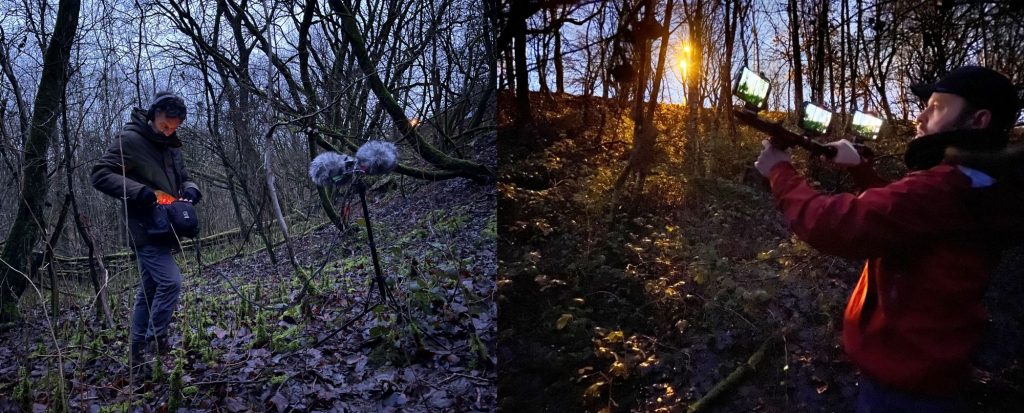
Simon Connor (left) and Andrew Brooks (right) recording on location
- What is it that excites you both about sharing your work in a festival setting at Sounds from the Other City (SFTOC)?
Andrew Brooks: It’s brilliant to be part of this year’s SFTOC, as I was involved at the beginning of the festival back in 2005. I created the first festival poster and light shows with projections at the after-party in Islington Mill during the first few years.
This festival and my time at the Mill were really important in mine and many others development as artists and producers. It showed us that we could create something ourselves, and not just be consumers of art and culture. The affordability and artist community in Salford created many possibilities, and the momentum generated during this time was really important to my early career as an artist and still drives the work I do now.
Simon Connor: SFOTC has such a varied and vibrant programme, the lineup this year looks fantastic so its brilliant to be a part of that. This will be a great opportunity to share our work with new audiences, who can step into an immersive audiovisual work and experience the wild spaces and urban edges of Salford in a new way. We’re hosting this in the University of Salford Bandroom this year, with 3-channel video and spatial audio, so will be quite a unique event.
- From the Edges is such a layered work both technically and conceptually – are there any sources of inspiration that you have found particularly significant during your research for this specific project?
Andrew Brooks: I’m a great admirer of David Hockney’s work, particularly his joiner artworks, which he created from many Polaroid photographs. These artworks capture a single view from multiple perspectives, a similar approach to Cubist painting and also to how we experience moving through the world, as our attention shifts from place to place. This fed into the camera setup I built. I deliberately positioned the cameras so that they were spaced apart and do not align precisely, in order to capture multiple viewpoints simultaneously.
I also looked at the films and photography of Russian director Andrei Tarkovsky whilst developing this project. The way he captures a dreamlike version of natural landscapes fed into our work, as did his camera movements and the way the limitations of the camera technology he used are visible. These imperfections somehow add to the beauty of his films.
Simon Connor: For this project I’ve been doing some research into the past of our chosen green sites of Salford (mainly Kersal Dale, Clifton Country Park and Woolden Moss) which has been fascinating – particularly how these sites have evolved and regenerated from their industrial past. Cal Flyn’s book Islands of Abandonment has some resonant themes in this area and how wild habitats grow and reclaim the land, so I’ve been considering how some of this might be explored in the soundscape. Composer Ben Frost’s music often blurs and and blends between industrial textures and organic sources, so has highlighted some interesting possibilities.
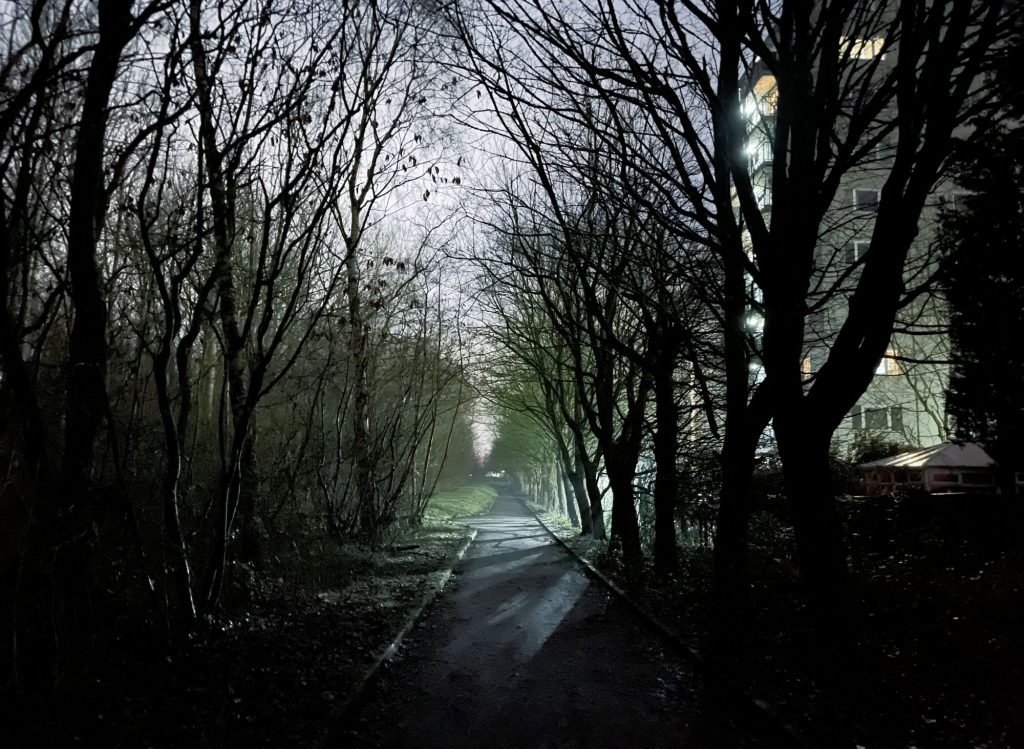
Andrew Brooks and Simon Connor, still from From the Edges (2026), three channel video and immersive sound installation
- What are your favourite aspects of Salford as a place and community?
Andrew Brooks: During this project we spent time researching the places of wild nature in Salford. Many of these were previously industrial landscapes, such as canals, mosslands, and old mines. It was fascinating to explore this side of Salford and see how nature has long since reclaimed these spaces. It took a while to tune into the signs of their previous industrial uses, but over time we found the remains of canal boats peeking through the topsoil and the foundations of grand villas among the tree roots. Before this project I hadn’t spent much time exploring the landscapes in Salford, so it was a chance to look into this fascinating layering of history and nature.
Simon Connor: Salford has a very supportive creative community, especially around music and sound. There’s a great number of interesting creative projects going on in and around the city, sometimes these are hidden below the surface but SFTOC is great at championing these. Our particular project has also shown me that there’s a wealth of interesting, overlooked green spaces around the city and borough too – especially when you consider how some of these have grown and developed from their industrial past.
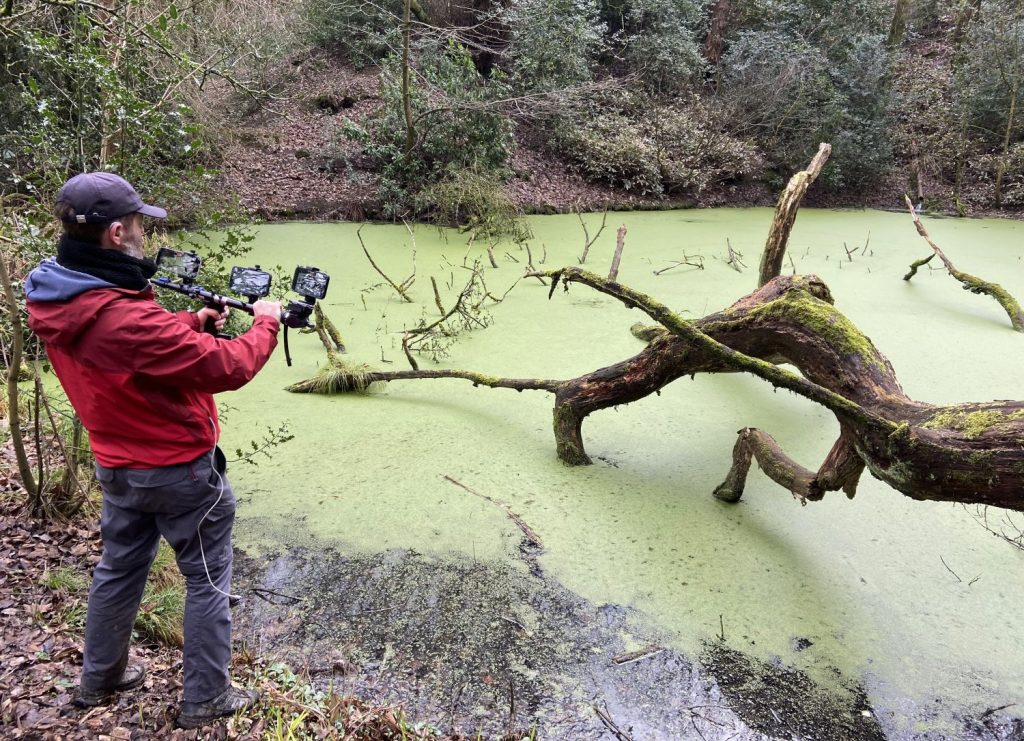
Andrew Brooks recording on location
- Where to next? Have you got any projects in the works or any concepts you would like to explore in future work?
Andrew Brooks: I like to play with new ways of using technology to capture and share places as we did in this project. With this in mind I’m currently developing a series of stereoscopic 3D films and stills, including a new artwork capturing the magical landscape of Lud’s Church in Staffordshire. It would be great to collaborate with Simon on these artworks and combine 3D filmmaking with spatial audio to really transport the viewer to another place.
There is always a challenge in sharing 3D films with the public, so another aspect of this work is developing useful systems that allow people to experience these works in exhibitions and festivals.
Simon Connor: We’d definitely like to expand the collaborative process we’ve developed together here with FTE, exploring and presenting different environments via immersive audio and 3-channel video. I think this offers unique means for presenting and experiencing a sense of place.
I currently have a few collaborative projects in the works, one of which is working with members of the London Philharmonic and the Carousel Chorus, who are making a suite of compositions all about Wakehurst gardens. I’ve been recording sounds from Wakehurst then bringing these to the rehearsals to help inspire and shape the compositions. It’s been great to see how this process and sounds of the environment can inform and inspire the music-making of others.
From the Edges makes up part of Sounds from the Other City’s festival programme. To attend a viewing of From the Edges, visitors must be Sounds From the Other City ticket holders.
Viewing slots for From the Edges can be booked at the wristband exchange on the day of the festival, tickets are distributed on a first come first serve basis.