Dr. Alexandra Mitchell, University of Salford Archivist reflects on the City of Making exhibition; touching on the University’s origins, the School of Art and student experiences.
Walking into the City of Making exhibition, one of the first things you encounter are three striking, enlarged photographs from the University’s Photographic Archive Collection. Each captures a pair of hands engaged in the act of making: a paintbrush mid-stroke, a needle guiding thread through fabric, a compass on paper. They are simple images, but they immediately say something about the care and skill that goes into creative and technical work.
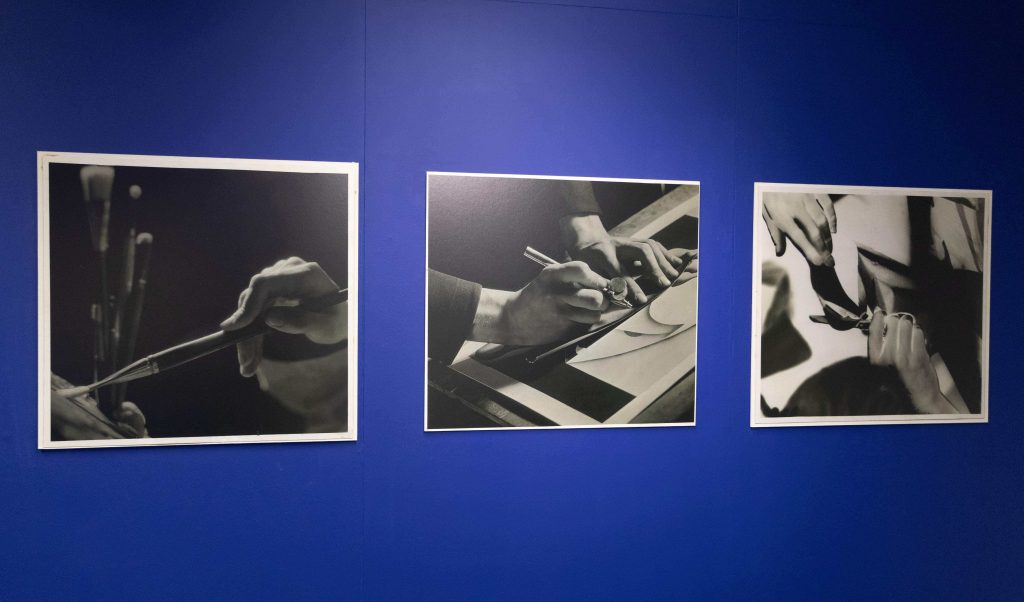
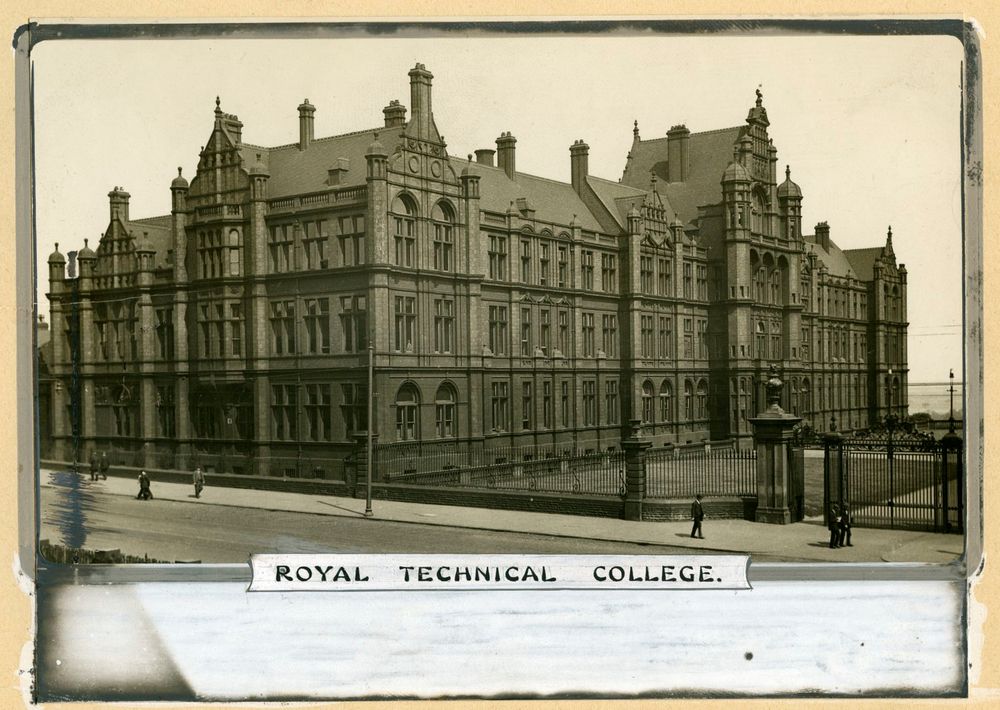
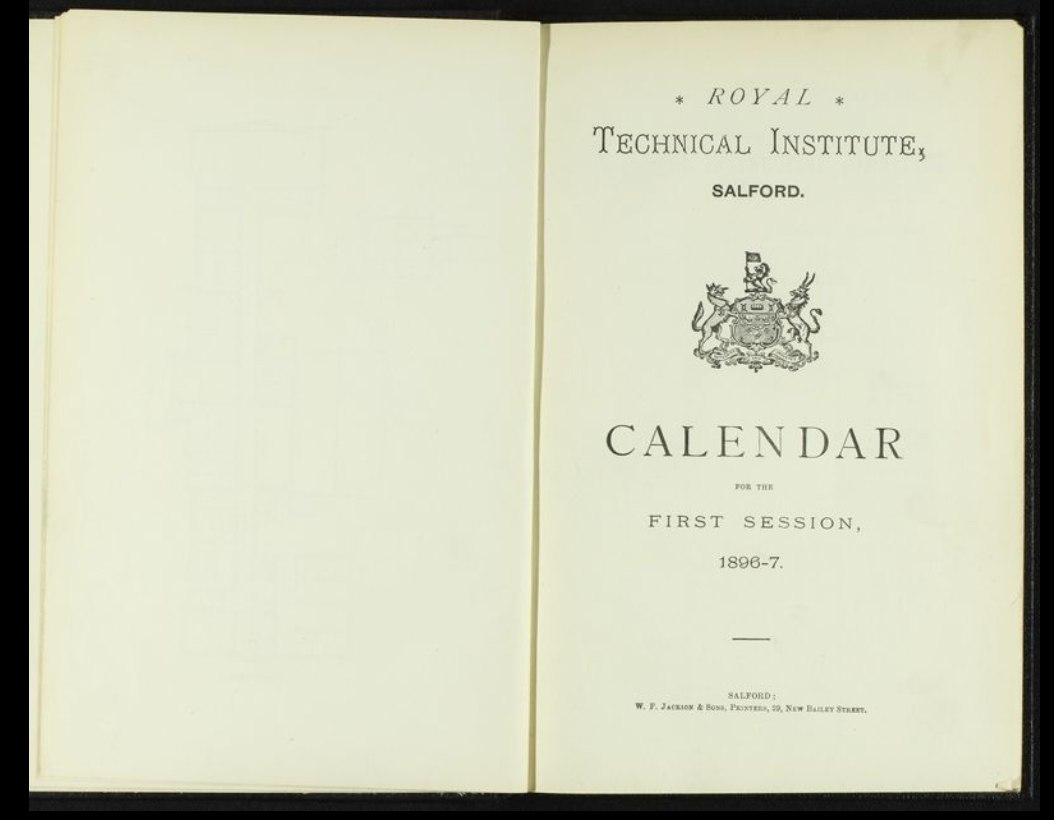
The photographs (above) date from the 1930s, when the building we now know as the Peel Building (above) housed the Royal Technical College, Salford (RTC). The RTC—originally established as the Royal Technical Institute in 1896—was one of several ‘whisky colleges,’ so-called because they were funded through alcohol duties. As stated in the first prospectus (below), the aim of the Institute was:
‘to provide [Salford] systematic instruction in those branches of knowledge which have a direct bearing upon the leading industries… The instruction will be to a large extent practical – the main purpose being to demonstrate the application of the principles of Science and Art to the various trades and industries.’
Essentially the Institute was intended to train a skilled industrial workforce in the art and science of ‘making’.
Built for Salford
Since its foundation, the Institute was organised into nine departments: mathematics; mechanical engineering; applied physics and electrical engineering; chemistry and metallurgy; dyeing, printing and bleaching; the building trades; cotton weaving and spinning; domestic subjects; and the School of Art. This organisation reflected Salford’s economic environment—textiles, engineering, manufacturing, and transatlantic trade through the Manchester Ship Canal. Courses typically ran from September to July.
The three photographs featured in the exhibition appeared in the 1930s prospectus for the School of Art, illustrating the courses offered in Crafts and Applied Design. Students studying Crafts could learn bookbinding, etching, leatherwork, jewellery making, embroidery, pottery, and stained glass.
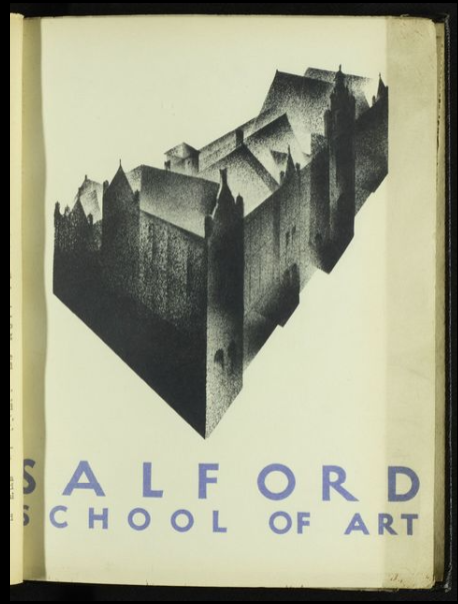
Applied Design offered weaving and hand looming, woodcarving, lettering and illuminating, and painting and decorating. Many of these disciplines feel familiar today, but at the time they were directly tied to local industry. Weaving and hand looming, for example, were recommended for ‘producers and salesmen of woven fabrics wishing to improve their knowledge of art as it applies to woven fabrics.’
Block printing on fabric was a particular specialism, aimed at students aspiring to become textile designers. They had the opportunity to design and print a range of fabrics, including handkerchiefs and bedspreads, learning techniques that could be carried directly into industrial roles.
Work and study
Reflecting the needs of the city’s workforce, the School of Art—like the rest of the institution—offered a mix of full-time and part-time day courses, alongside a programme of evening classes. These evening sessions enabled those in employment to expand their knowledge and skills after work, and they became a defining feature of the Institute’s offer.
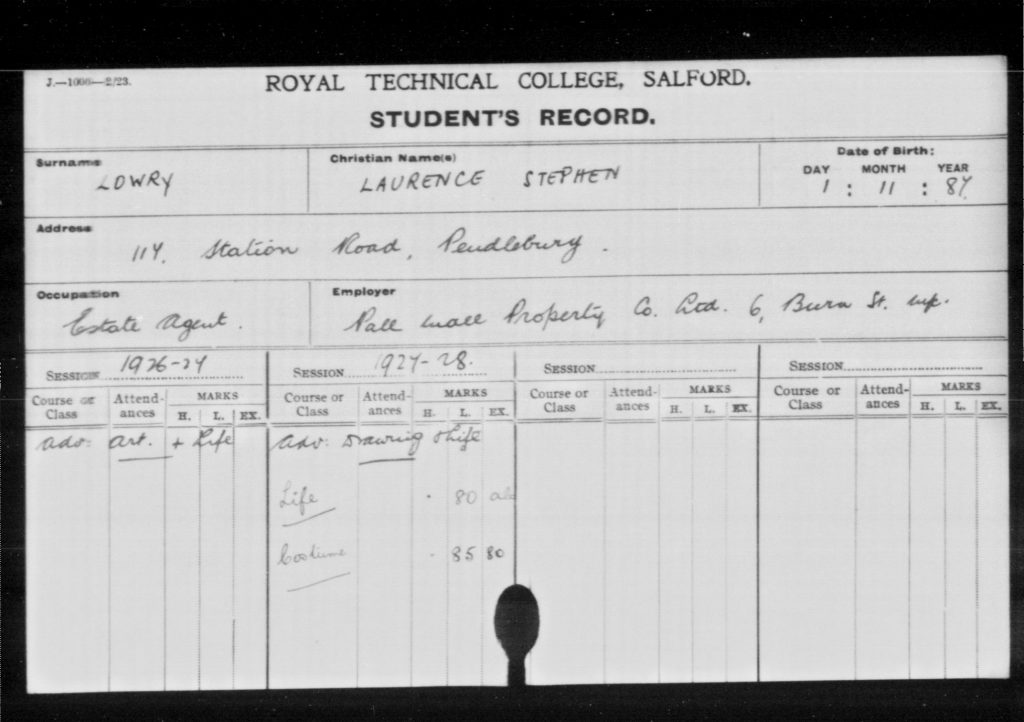
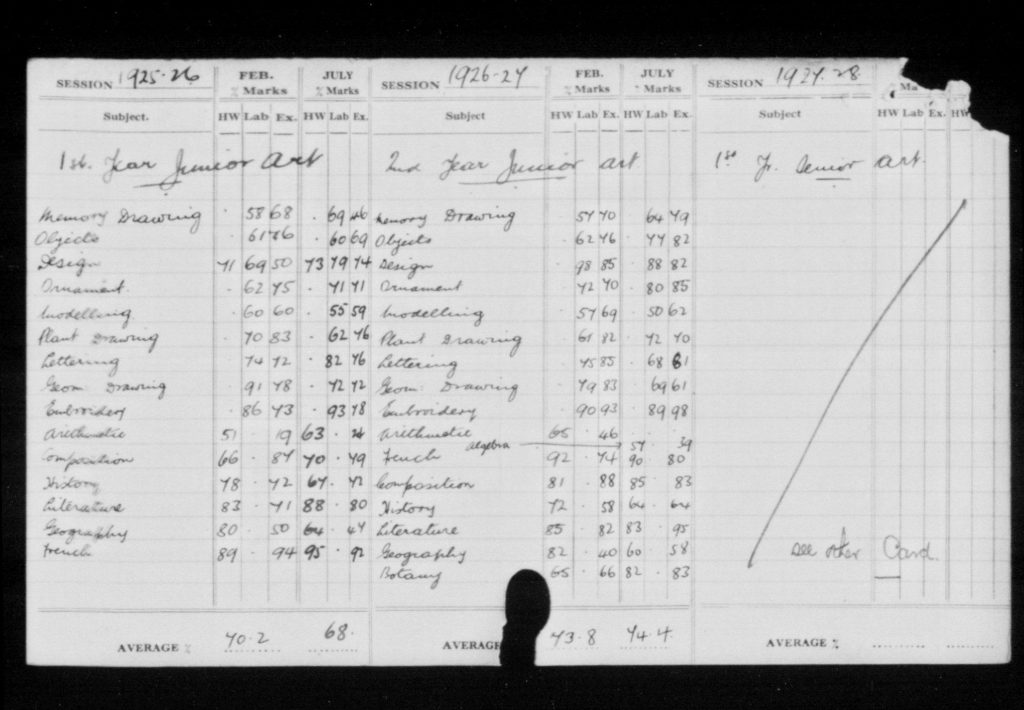
It was the evening classes that L. S. Lowry attended. His record card documents his time studying advanced art, life and costume drawing, training which no doubt he carried not his work as a practising artist.
Other students followed more commercial routes: Clara Elizabeth Robinson, known as Betty, became a textile and graphic designer with commissions from WHSmith and Tootal. Their stories show how the RTC nurtured both artistic talent and practical craft for industry.
Student Experiences
Throughout the early history of the RTC, engineering courses consistently saw the highest enrolments. The School of Art attracted fewer students, though this may have been due more to space than demand. Student numbers in all departments fluctuated during the 1930s, a period that saw economic instability and the increasing threat of war. The exception was the number of day-release students which rose, suggesting that employers valued the combination of education and workplace training and were willing to allow apprentices and employees time to attend classes.
The student body was overwhelmingly local: in the early years over 80% came from within the borough of Salford. As time went on, more students were travelling in from outside, including from Liverpool, Buxton, and Stalybridge. This shift hints at the growing reputation of the Institute and the strength of Salford’s industries.
A history of ‘making’
April 2026 marks 100 years since Salford became and city. The University of Salford traces its history back to the Royal Technical Institute and the RTC and is inseparable from the history of the city that shaped it. The Royal Technical Institute—and later the Royal Technical College—was founded to support Salford’s makers, engineers, designers, and tradespeople. The City of Making exhibition brings the connection full circle – the act of ‘making’ runs through the historical, cultural and educational identity of the city.
Dr Alexandra Mitchell, March 2026
Want to learn more about Salford’s historical and contemporary acts of making?
Why not join us at the gallery on Tuesday 21st April 2026, 1PM – 1:30PM for an informal gallery tour of City of Making, led by curator Stephanie Fletcher and Dr. Alexandra Mitchell, in celebration of Salford’s 100th anniversary of having city status.
All welcome, public, students and staff!
Free to attend – Booking is not required, however if you’d like to register and receive an event / calendar reminder, click the link to ‘Reserve a Spot’!
New Adelphi Exhibition Gallery, Ground Floor,
New Adelphi Building
University Rd, Salford
M5 4BR
Access:
– Free to attend
– Wheelchair accessible
– Come alone or with friends
– Staff available throughout
– All welcome but young people MUST be supervised
– Sensory environment: well lit, no noise, may get busy at times (max 20 people)
– Time out: Seating, quiet space, toilets, water refill and cafe nearby
– See our visit us page for more info/travel/etc
– contact us: artcollection@salford.ac.uk for any queries!