For 2026’s Women’s History Month, Team Assistant Keira Marchant is highlighting some interesting female artist made pieces in our Collection – discussing women’s experiences with gender, identity and social roles and how these themes span across the diverse and varied works of four Northern based artists.
This March presents the perfect opportunity to highlight the contributions of Northern based female artists to both our Collection and of course to arts and culture in its entirety – people who have laid down the foundations for women in the arts, and who have contributed masses to culture in the North, creating a vibrant and supportive community in which I’m lucky enough to start my career.
At the Art Collection I feel very privileged to be surrounded by an abundance incredible art, so I am delighted to have the opportunity to shine a light on some of these brilliant artists and their pieces in our collection.
Sarah Hardacre
1.) Arms Open to Welcome the Sun, 2012 (left)
2.) Forget Mermaids, 2012 (right)
Screenprints
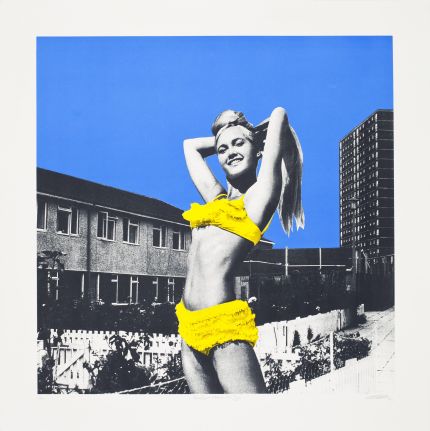
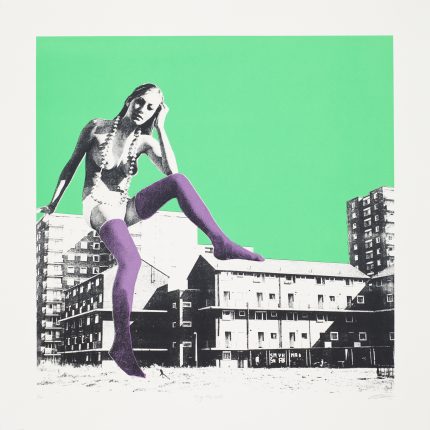
Sarah Hardacre is an artist working in Salford, her work centres on the experiences of Northern working-class women and how they fit into the structures of urban architecture and housing developments – developments that were bult fast and cheap, prioritising convenience over community, and consequently almost stripping the sense of belonging and local identity from their inhabitants.
Through collaging images from local Salford history archives and clippings from second-hand gentlemen’s magazines, Arms Open to Welcome the Sun and Forget Mermaids juxtapose the natural curves and contours of the female body with the easily replicated utilitarianism of inner city housing estates and developments. In this contrast, Hardacre satirises the government’s attempt and subsequent failure from the 50s-70s to impose a genericised way of living on working-class communities.
The woman in Arms Open to Welcome the Sun is beaming, carefully sliced from her warm and glamourous origins by the beach, and placed into the cold grey uniformity of a Salfordian estate; nevertheless she continues beaming, bringing the unnaturally blue sky with her.
The woman in Forget Mermaids is comparatively pensive but just as unapologetically out of place – purple stockings, huge beaded necklace; a bohemian sat on uniformaly brutalist flats.
These women are giants within their landscapes, too bold and immense to be packaged into the ‘one size fits all’ genericism of the estates which they are cut and pasted into.
Hardacre’s screenprints resonate particularly with me, through the experiences of both my grandmothers. Both grew up in very tight knit working-class communities, and to this day they maintain very strong identities with where they previously lived, one in Cliff Vale in Stoke-on-Trent and the other in the Garngad, Royston Hill, Glasgow. Both of their childhood homes were demolished during redevelopment and both moved into council built estates.
Hardacre’s prints make me wonder about the isolation that comes from being uprooted and inserted into a house elsewhere, forced into a life of replicated and clinical domesticity, built on the ideals associated with the modern nuclear family unit.
The contrast between these vibrant, outrageous and confident, although heavily feminised figures, with the drab grey estates which they tower over, reminds me of the quirks, humour and outrageousness in my grandmothers that redevelopment wasn’t able to quash – they are each completely and utterly characters to this day. Their lives and personalities along with the lives and personalities of all women in similar positions are, to me, active protests against the ‘well behaved’ cut and paste lifestyles that were desired to be instilled into communities through the creation of these estates.
Sarah Hardacre’s work is represented by Paul Stolper Gallery, London. To learn more about Hardacre and her work, visit her website here.
Sarah Ayre
Twitch, shift, jerk, slip, repeat (2020)
Digital GIF series
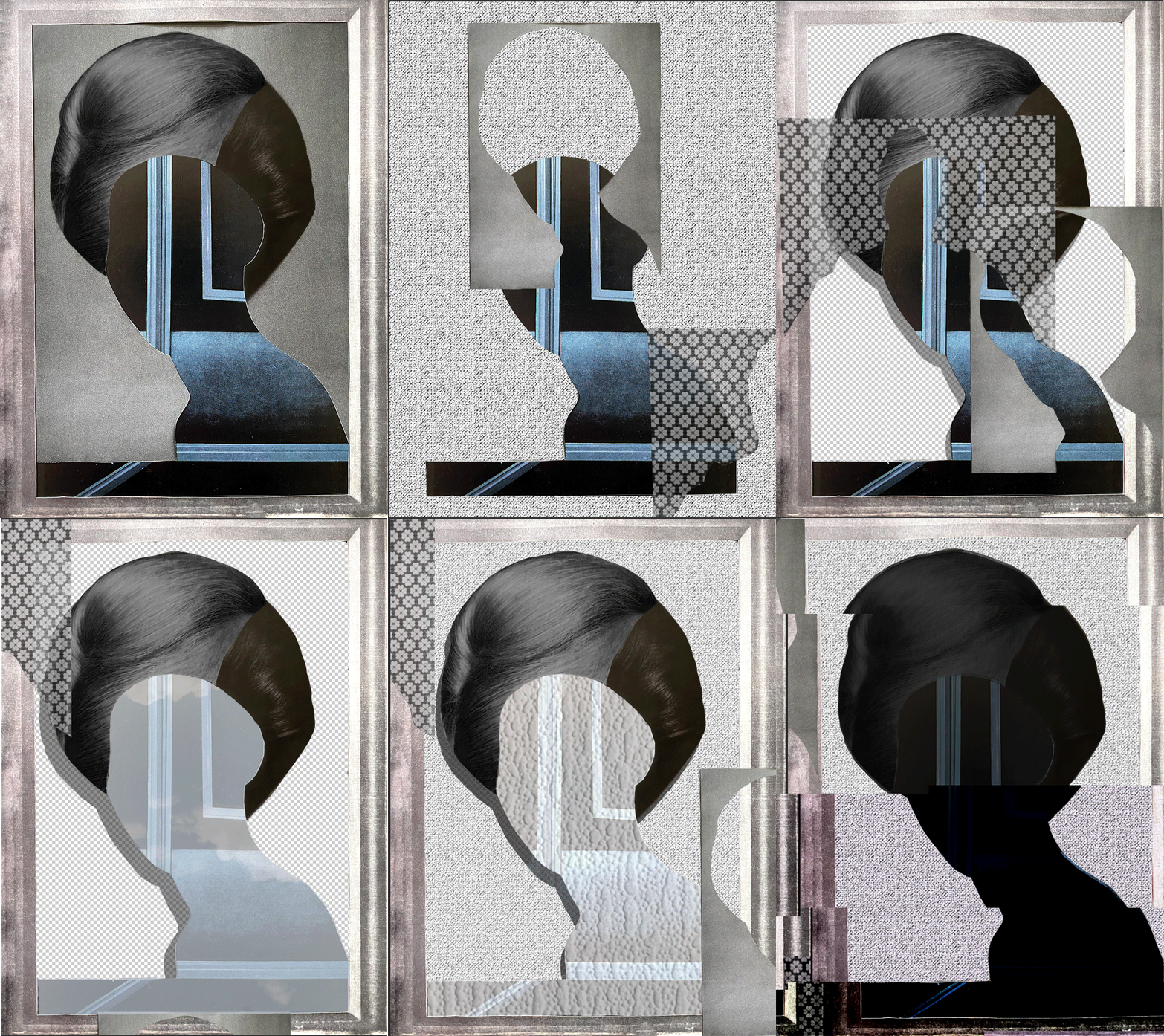
Click to view each GIF:
1 – Untitled (Curtain)
2 – Untitled (Heads)
3 – Untitled (Melt)
4 – Untitled (Morphing women)
5 – Untitled (Zooming backgrounds)
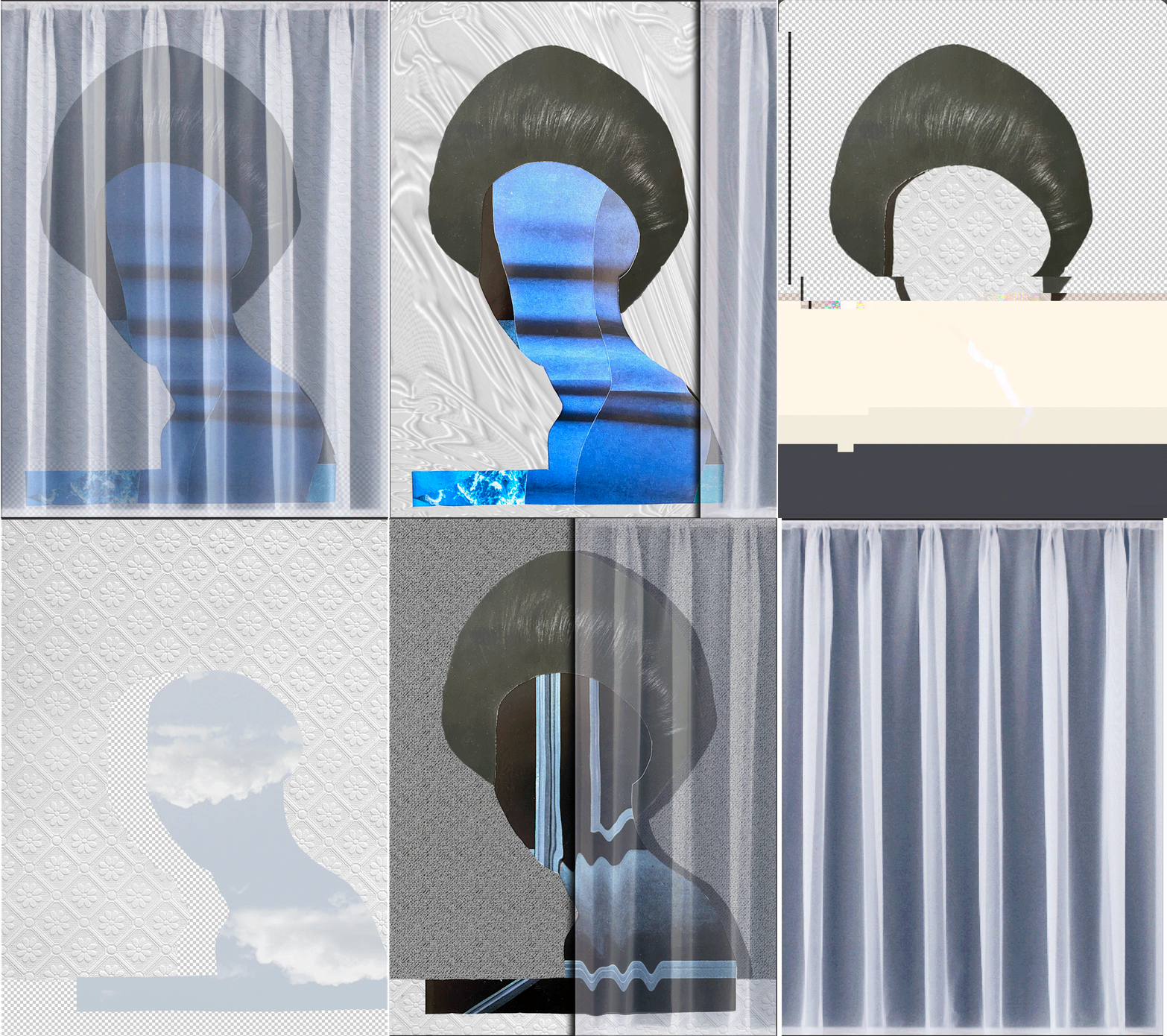
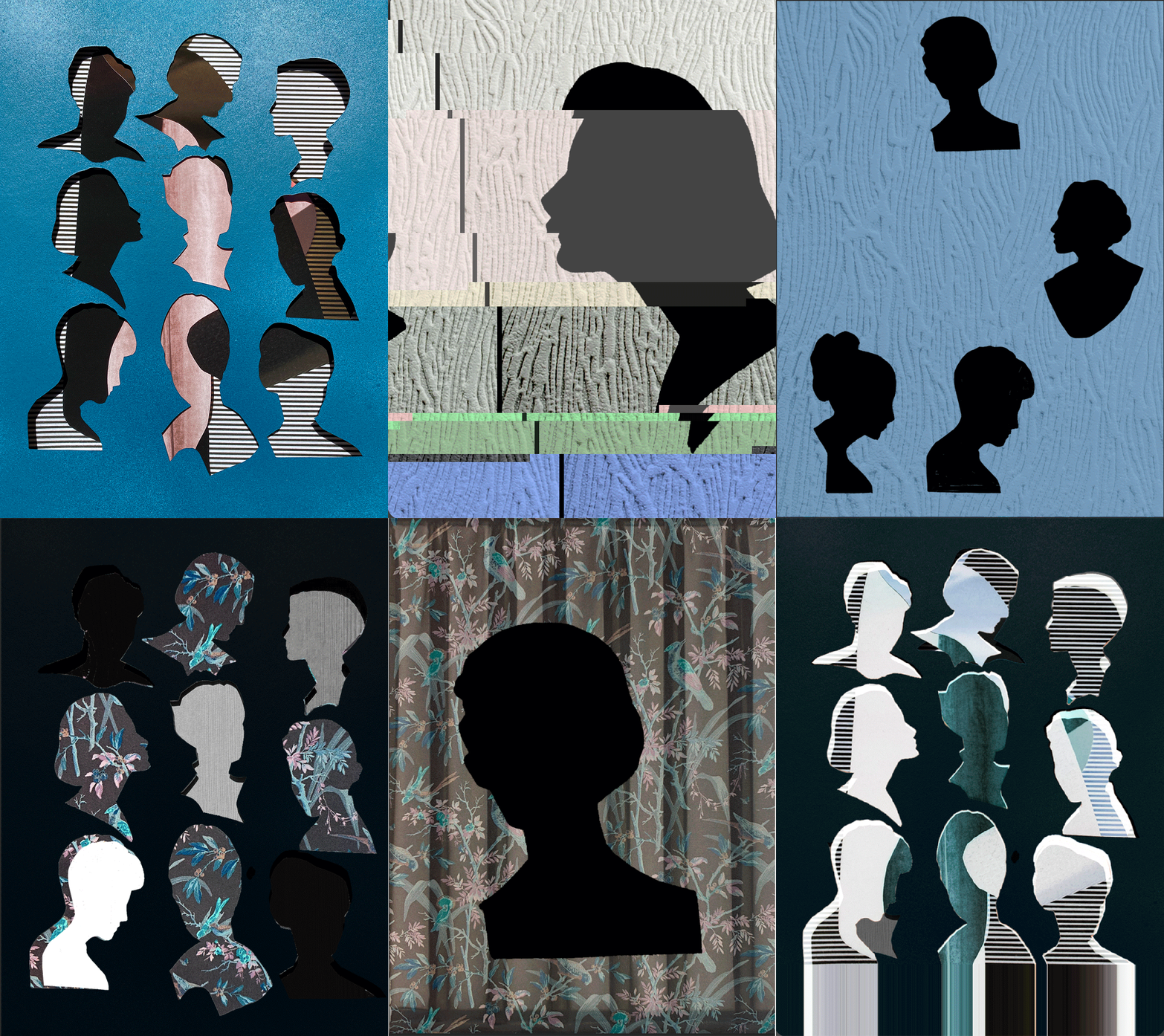
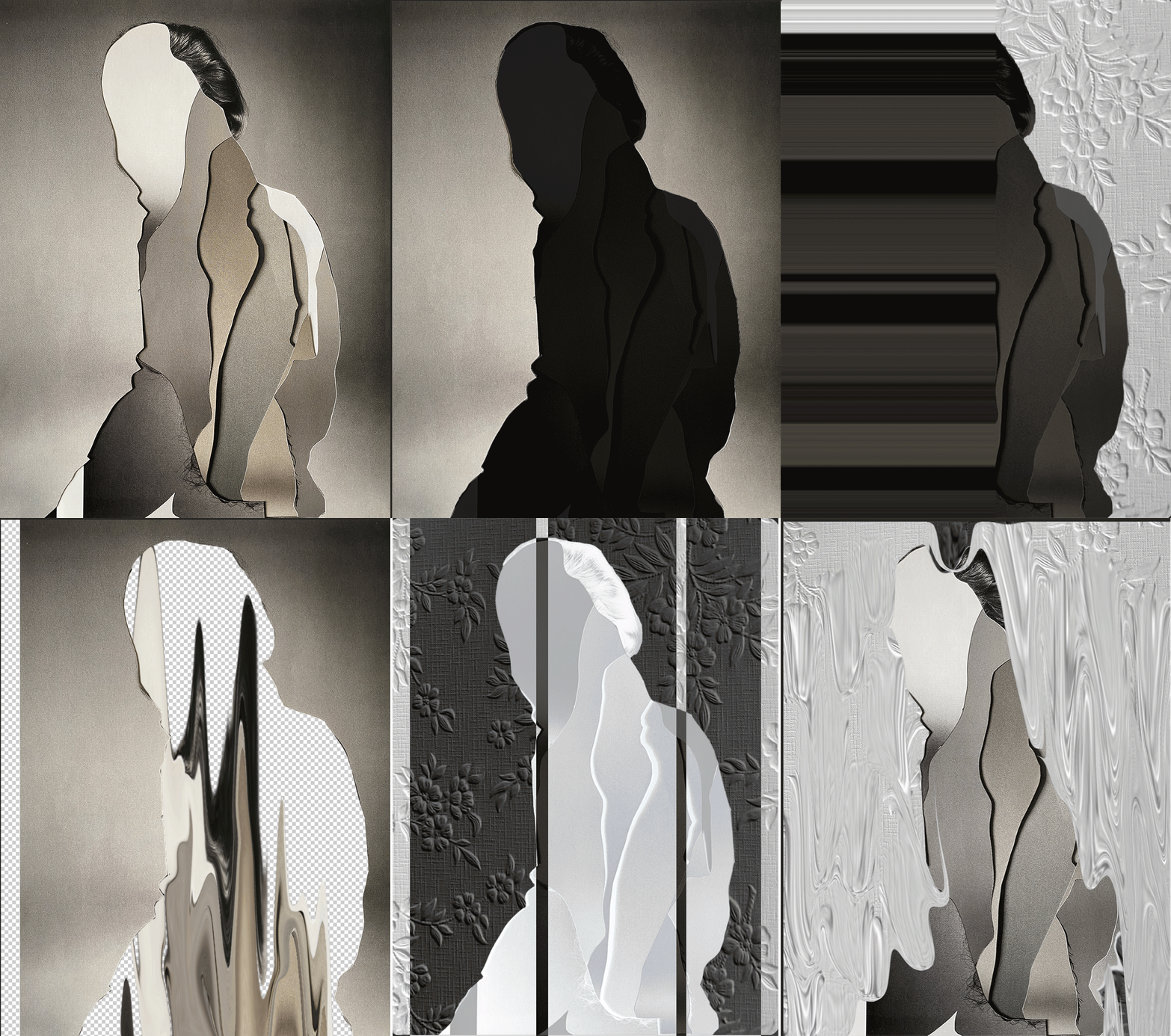
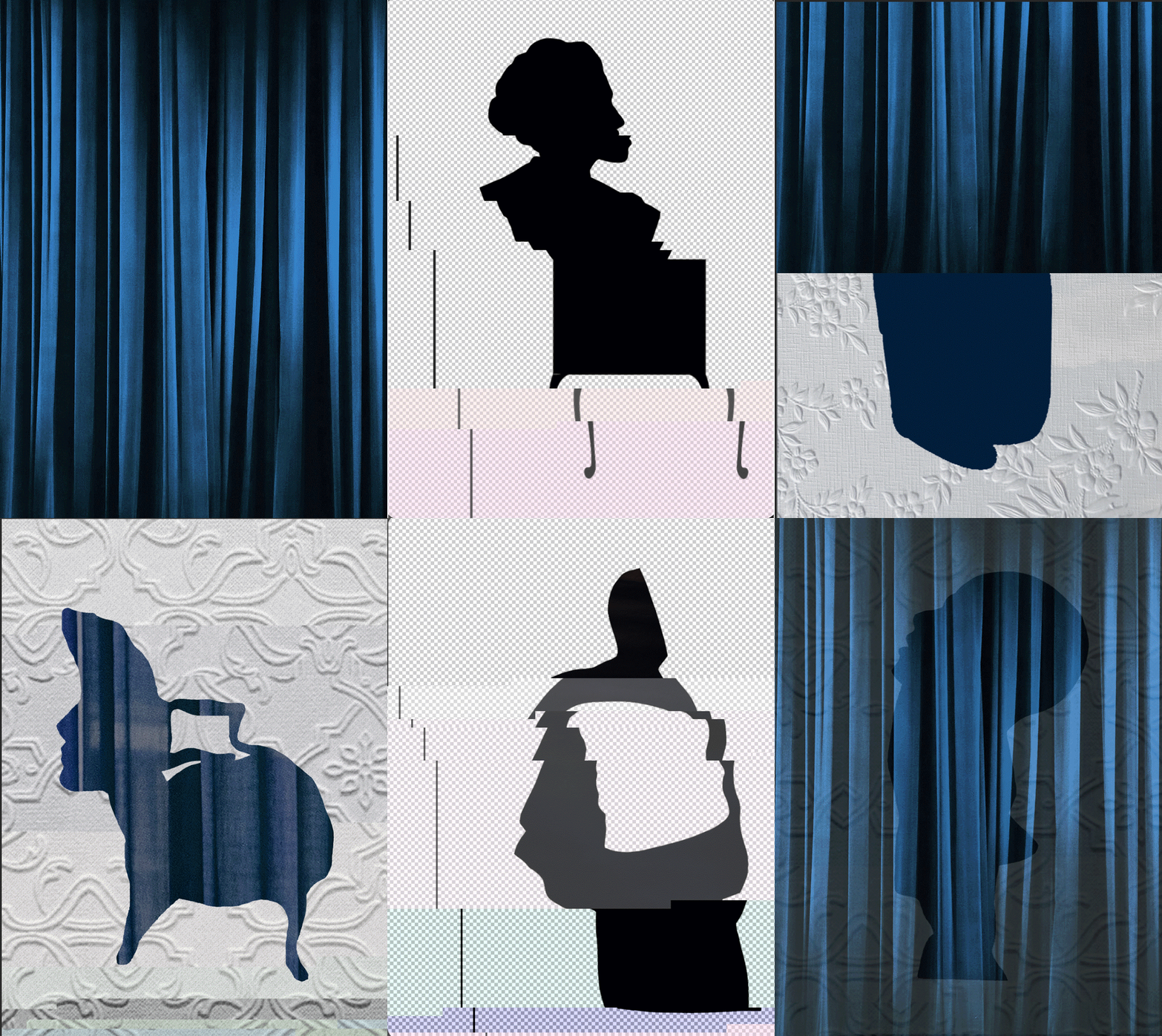

(Please note: the above images are animated GIFs, and uses flickering images. It may take a few moments to load on some internet connections)
Above: Untitled (Zooming Backgrounds)
Sarah Ayre’s Twitch, shift, jerk, slip, examines the gender disparity in the impacts of global and national crises, focusing on women during the Covid-19 pandemic. Her work delves into the way in which women are often more likely to suffer economically through events like Covid, and how lockdown, through confining women to their homes also re-traditionalised them, placing them directly in the domestic sphere. Ayre’s works maintain similar themes to Hardacre’s, this time bringing the conversation into the digital world.
Digital GIFs combined with paper collage is Ayre’s unique method of demonstrating the repetition associated with life in lockdown, the constant looping and the splicing of photographs visualising days that are fragmented but indistinguishable. Patterns and colours repeat across all of the GIFs, and when viewed in a sequence they feel uncanny and clinical, sometimes monochrome, sometimes the same hygienic blue of medical gloves and scrubs.
With the rise in use of online spaces as platforms for misogyny, works by artists like Sarah Ayre are more relevant than ever as, many current discussions on harmful misogynistic content are focusing more on the contexts in which it is made by men, rather than the harm it poses to women both online and offline. Ayre’s Twitch, shift, jerk, slip, repeat places women at the centre of the discussion, by visualising the disorientation felt when gazing out at the world through windows and screens, and the fragility of our carefully curated and fabricated online identities. Twitch, shift, jerk, slip, repeat is the slipping of our mask, the reveal of the quiet empty domesticity felt by women pushed back into the house.
Looking at these pieces, is a reminder that the effects of Covid are still raw, still fresh in our collective memory. The consequences of pushing young people into isolation, at the mercy of tech giants and algorithms that profit from polarisation, rage and fearmongering, still continuing to emerge.
These works were aquired as part of our Covid commissions programme in 2020 which was ran by the Art Collection in collaboration with key partners across the North West, with the aim of capturing contemporary experiences during the pandemic, as well as supporting artists who may have otherwise lost work.
Sarah Eyre is Northern based artist working with photography, moving image and collage. Her practice often combines found imagery, her own photography, animation and sculptural artefacts. For more information on the artists work visit her website here.
Cecile Elstein
A Letter to Mrs Gould (1981)
Screenprint
Cecile Elstein (née Hoberman, 1938-2025) was a South African-born British artist whose career spanned across sculpture, printmaking, drawing, and environmental installation. Born in Cape Town in 1938, she moved to England in 1961, and settled in Manchester in 1977 becoming a principal figure in the area’s arts scene.
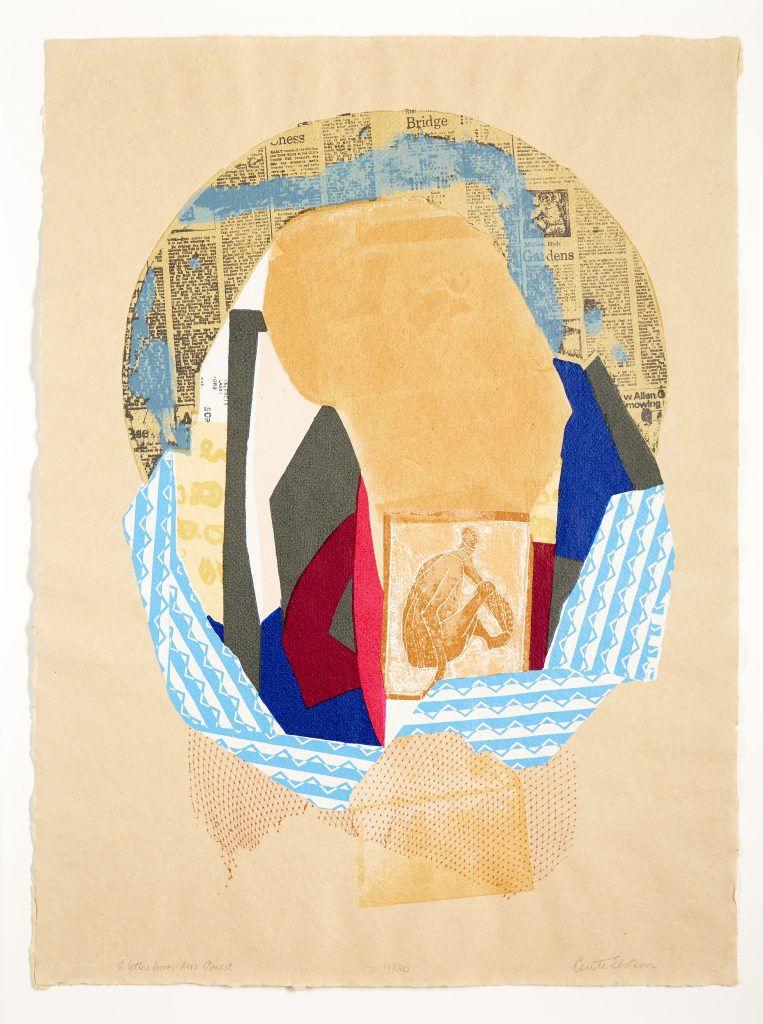
Mrs Gould’s letter reads: “Woman needs work urgently – cleaning & domestic work – housekeeping – gardening – handywoman – will do work of any description – hours to suit you – at a rate you can afford….”
A Letter from Mrs Gould is Elstein’s response to a letter she received. She understood this distinctly reflected the socioeconomic conditions in Manchester and the UK in the early 1980s as felt by a woman trying her hardest to keep her head above water, in a period where unemployment was at its highest since the great depression. During this time economic inequality and wealth disparity was rising rapidly, with industrial heartlands in the North, Wales and Scotland declining while the economy in London and the South East was booming.
Elstein’s screenprint pieces together the circumstances of Mrs Gould’s life at the time of writing her letter using found materials: netting from a bag of oranges with a 50p price tag, showing increasing cost of living; a newspaper cut out giving a visual reminder of the news events which were chipping away at the ability for people like Gould to get by; and the envelope in which Elstein received the letter. The print is an image of dignity and perseverance of women boldly facing hard times.
To me the act of giving and the act of receiving the letter, underpins the entire piece – the letter, a message sent out into the void, the painting, a voice calling back. The tenacity of both the artist and Mrs Gould, and their defiance in the face of inequality, are just as significant today; since the 1980’s wealth disparity has continued to increase, with its current level much higher than when Elstein received this letter.
Cecile Elstein was a member of the Manchester Print Workshop, which opperated out of the University of Salford from the late 1970s until the mid 1980s.
You can see more about the life and work of Cecile Elstein here.
Mandy Cleveland
Back of the Envelope series (2020 onwards)
Drawings on found paper
Acquired as part of our Covid commissions programme, Mandy Cleveland’s Back of the Envelope series focuses on quiet introspective moments, which we experience as an escape from the attention demanding news cycle that we are constantly exposed to through technology.
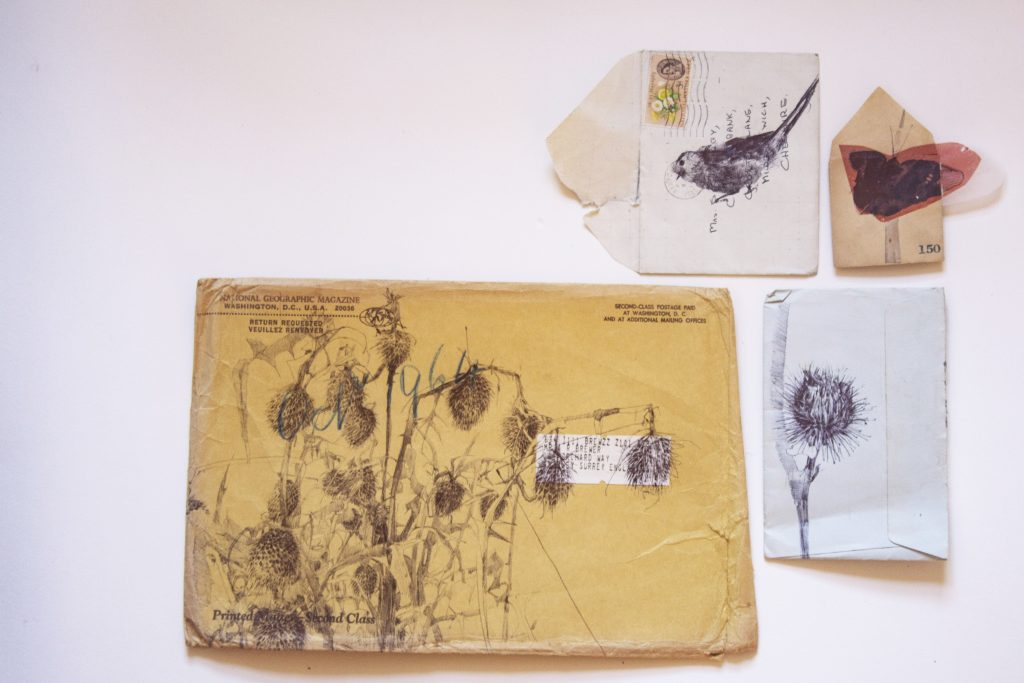
Mandy Cleveland, Thorny Burr (2020)
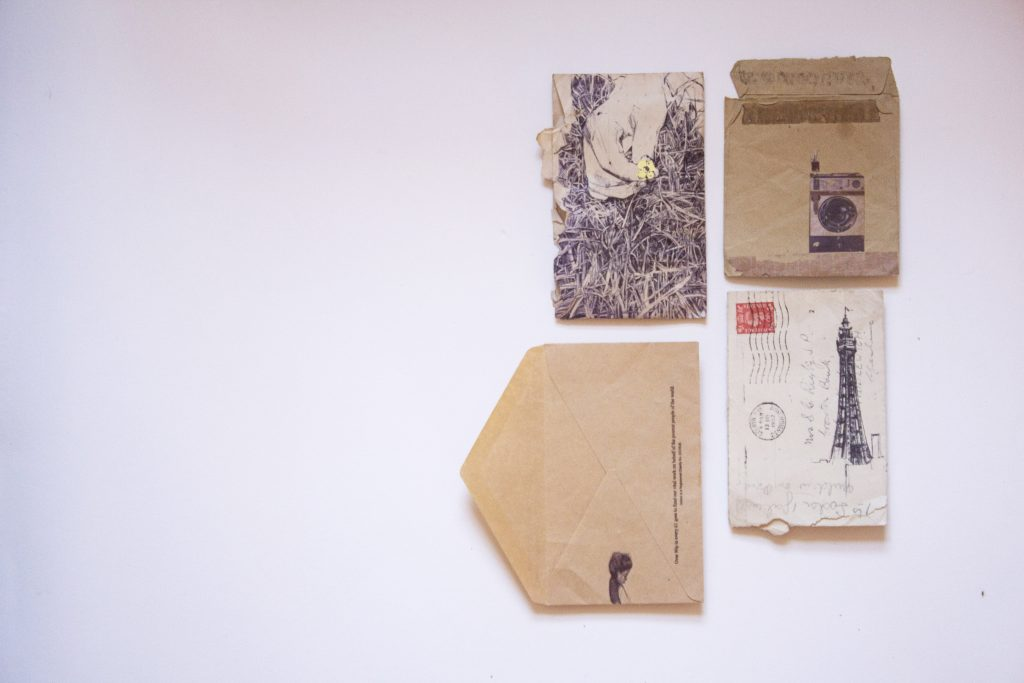
Mandy Cleveland, Buttercup (2020)
Cleveland’s delicate drawings on the backs of envelopes draw our focus to the act of looking mindfully at what is around, to reconnect to our environments and to slow down the fast pace in which we have become accustomed to live our lives. Created during lockdown, these pieces show a process of loss and regaining of hope; during this time Cleveland’s community workshops were put on hold, temporarily disrupting her income and creative practice while she was juggling childcare. Through these works she captures the intimate moment of stepping back and letting time slow down in times of stress and worry.
My favourite piece’s in this collection of drawings are Thorny Burr, and the careful, gentle winding of a tangled mass, scratchy and scribbled on to the envelope. These remind me of my time spent on walks during lockdown, trudging past bramble patches and bored out my mind – something that feels unbearable when you’re 16. I spent lots of time breathing quietly to not disrupt the blackbirds awkwardly hopping under the brambles looking for worms, looking at these drawings I think Mandy might have too.
Works like this present an important open dialogue between artists and audiences. By focusing on the commonality amongst women’s experiences and her own personal experiences, Cleveland creates a sense of strength and oneness. Seeing works like this, in which artists present their experiences earnestly, provides opportunities for audiences to feel understood in a way that might not be accomplished otherwise simply through words.
Mandy Cleveland, has a studio Hot Bed Press in Salford, works with found paper and used envelopes, combining drawing, collage and printing techniques, alongside her fine art practice Mandy also runs community workshops. See more of the artist’s work here on her website.
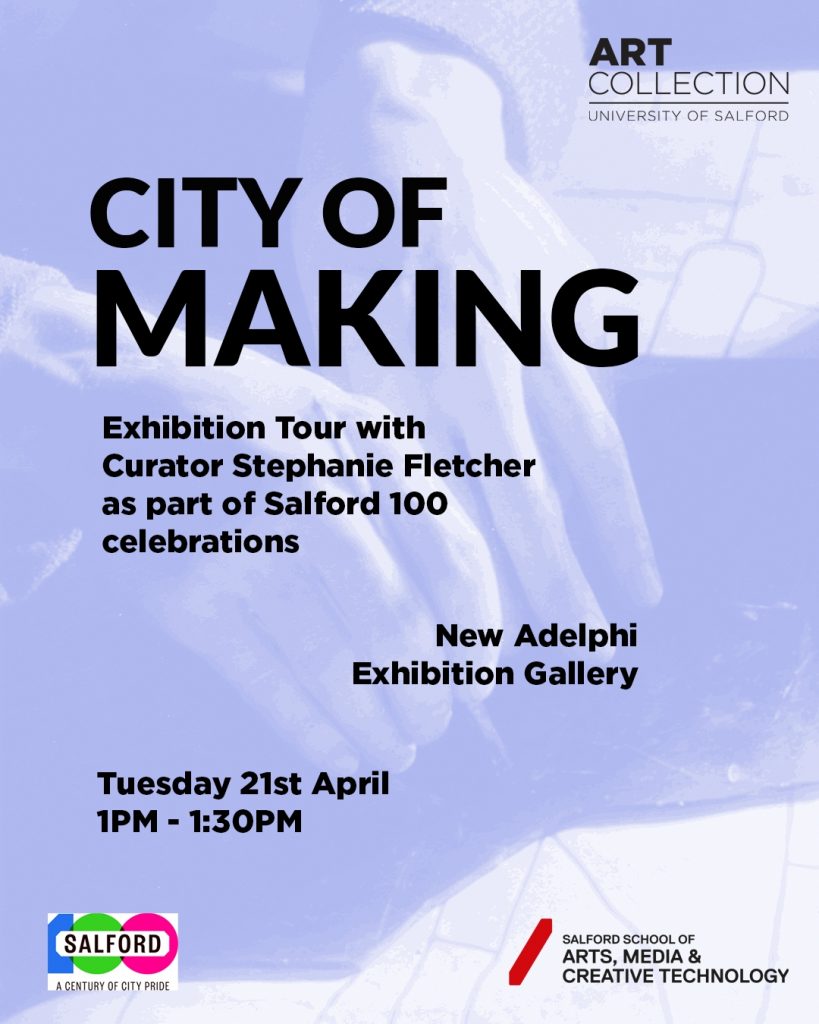
There is a wonderful chance to see some of the artworks discussed here at ourCity of Making exhibition at the New Adelphi Exhibition Gallery. Mandy Cleveland’s Back of the Envelope series and Cecile Elstein’s A Letter to Mrs Gould (1981) are on display until 3rd July 2026 alongside many other brilliant artworks. I thoroughly recommend you give it a visit!
Why not join us at the gallery on Tuesday 21st April 2026, 1PM – 1:30PM for an informal gallery tour of City of Making with curator Stephanie Fletcher, in celebration of Salford’s 100th anniversary of having city status.
For more details and to reserve a spot see: Curator Tour – City of Making Exhibition / Salford 100 Centenary Event – Art Collection